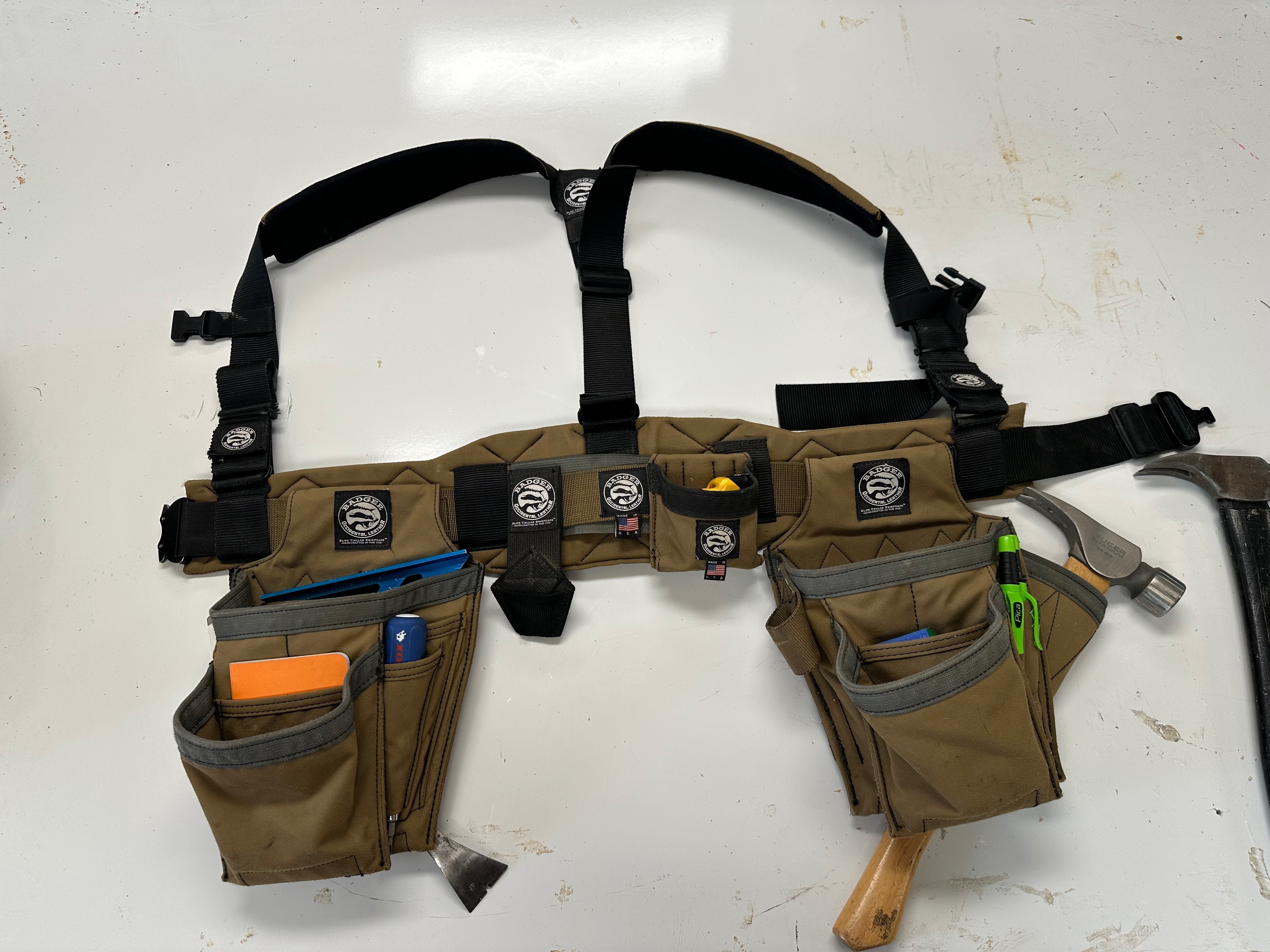
I bought a medium Badger B12 single tool belt setup in May 2025. Since then, I have worn it very nearly every day after work and through long weekends while renovating this house.
The work has included roofing, siding, framing, plumbing, electrical repair, window trim, and deck repair. That makes this less of a review from one specific trade and more of a report from a long, mixed remodeling project. I move between careful trim work and tearing things apart, sometimes in the same afternoon.
After more than a year of that, the B12 is one of my favorite purchases. It was an investment, but I would absolutely buy it again.
Why I chose the B12
The B12 was previously called the Trimmer V2. It uses Badger’s smaller 12-inch bags and weighs about three pounds before tools. I chose those small bags for their versatility and compact size.
I knew I would spend a lot of time kneeling, doing demolition, climbing ladders, and then moving indoors for fiddly trim carpentry. Large bags would carry more, but they would also be more likely to drag on the floor, catch on things, or get in the way when I was working in a tight space.
This collection of tools is geared toward remodeling and general maintenance rather than any single trade. I regularly move between different kinds of work, so I value compact tools that can solve several problems. It may not be the ideal setup for everyone, but it is what works for me.
The belt itself is far lighter than a traditional leather rig. The pockets and tool slots are well placed, and I can carry a useful general-purpose kit without feeling as though I am wearing everything I own.
Mine was a ready-to-ship set without customization. I am not sure I would change much if I ordered it again, although Badger’s side-by-side pouch option is interesting.
Fit, comfort, and buckle
I bought the medium belt. Follow Badger’s measurement instructions rather than ordering from your pants size. I sized mine to fit over my Carhartt overalls. Once adjusted, the sizing stays put and does not slip during the day.
The AustriAlpin COBRA buckle has been excellent. It is quick to put on and take off, and I can operate it while wearing heavy gloves. I once had a dog collar with a similar mechanism that would jam after the dog had been playing in beach sand, so I wondered how the belt buckle would tolerate construction dirt. It has never jammed or given me any trouble.
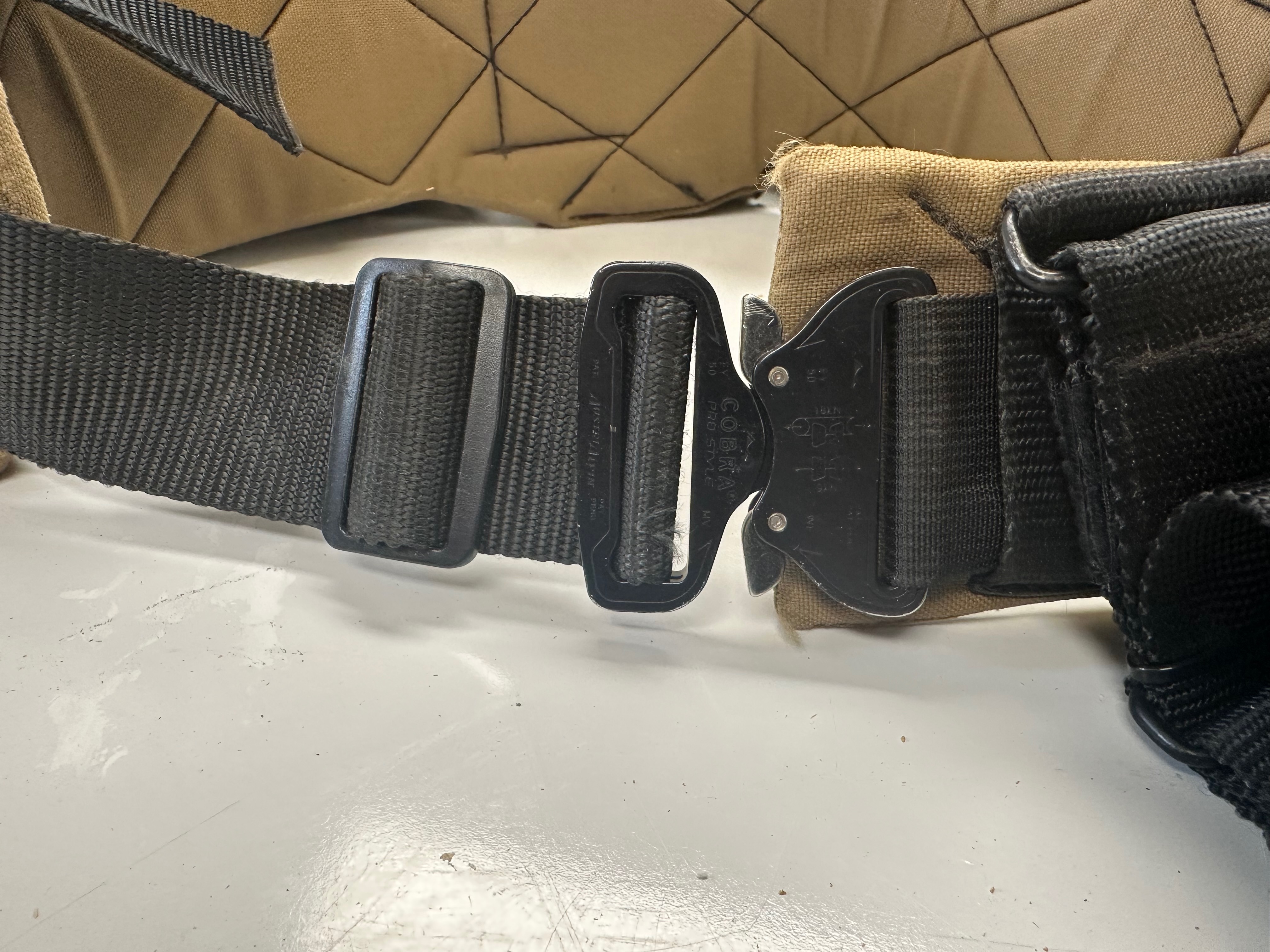
The release does require pressing both tabs. Someone with limited hand strength or arthritic fingers might find that difficult, particularly at the end of a long day.
Wear after more than a year
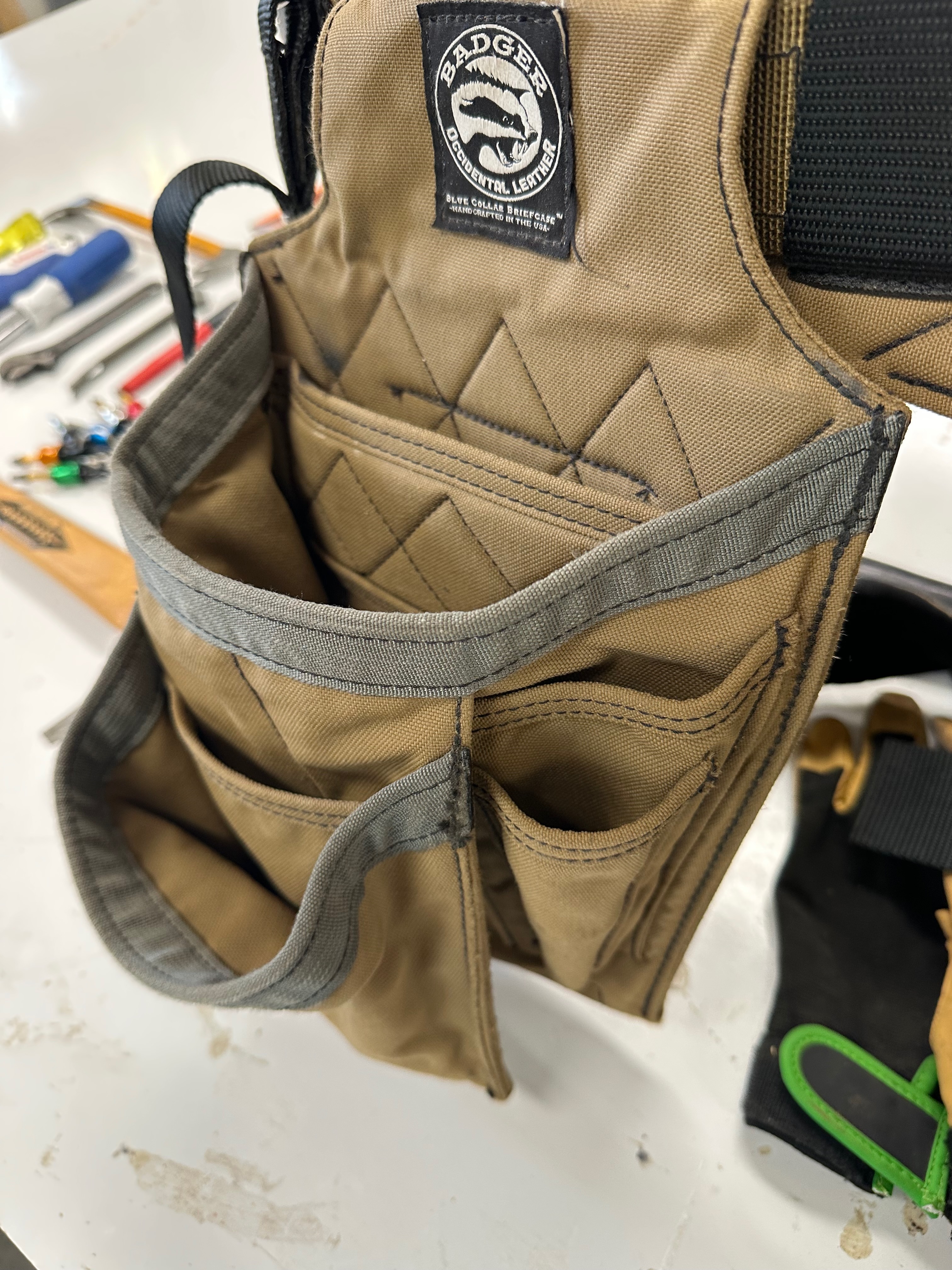
The fabric is not showing any significant wear after more than a year of frequent remodeling work. I do not have frayed corners, including on the cat’s-paw sleeve where I repeatedly insert and remove the beater chisel.
The pouches have not sagged or collapsed. They stay open on their own, making it easy to put tools away and retrieve them without holding a pocket open with the other hand.
I have kept the belt dry, so I cannot say how quickly the fabric dries after being soaked or how it holds up to repeated wet weather.
Adding the suspenders
The belt alone is wonderful. For lighter indoor trim work, it is enough by itself.
About six months ago, I added the Badger Comfort Suspenders. I was spending longer days on ladders with a nail gun, racks of nails, a heavy demolition bar, and a framing hammer in the pockets. Under that load, the belt placed more pressure on my hips than I wanted.
The suspenders distribute that weight well. They conform to my body, sit comfortably on my shoulders, and do not restrict my range of motion. The loops on the chest straps also make a surprisingly convenient place to stash a pencil.
I bought Badger’s Suspenders Rapid Release System because I expected to take the suspenders on and off. I have never taken them back off. I probably would not purchase the rapid-release system again. It works well; I simply have not needed to return to the bare belt in a hurry.
The gloves I wear
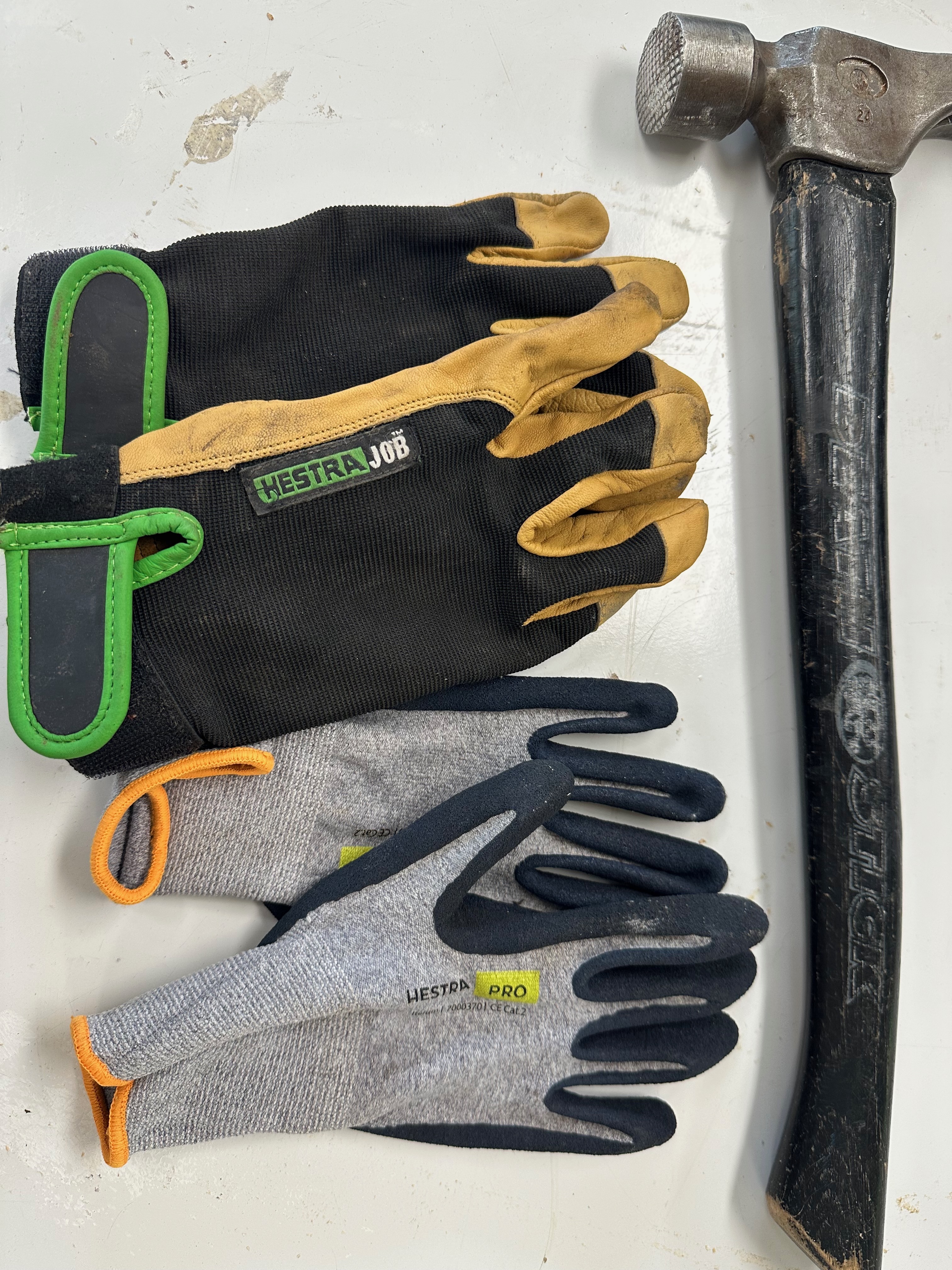
After my previous preferred glove brand became a little too “tacti-cool,” I switched to the Hestra Iterum and Golden Kobolt Flex.
I have known Hestra’s ski gloves for years. Its work gloves have been just as tough, with thoughtful seam locations, good fit and sizing, and excellent materials. The Iterum is a seamless knit glove with a coated palm and fingers. The Golden Kobolt Flex uses supple goatskin on the palm with a lighter fabric back. Both have been wonderful.
How I arranged the belt
The B12 has enough organization without forcing every tool into one particular location. I have made a few choices and small changes to suit the way I work.
Tape in the center
I added the Badger Tape Holster at the center of my lower back. That lets me reach the tape with either hand. Carrying it there will not suit everyone, but it works well for me.
The holster is nearly perfect for my 16-foot DeWalt ATOMIC tape after I remove its belt clip. The fractional markings make measurements easier for me to read and call out. I take the clip off so the tape slides in and out of the holster more easily—and so nobody can clip it onto their own belt and walk away with it.
The one-finger brake is easy to control. I sometimes wish the blade were a little stiffer, but the lighter weight is a worthwhile tradeoff in a tape I carry all day. A larger 30-foot DeWalt does not fit this holster as well. Badger makes a larger tape holster if that is what you prefer to carry.
Two full-depth pencil slots
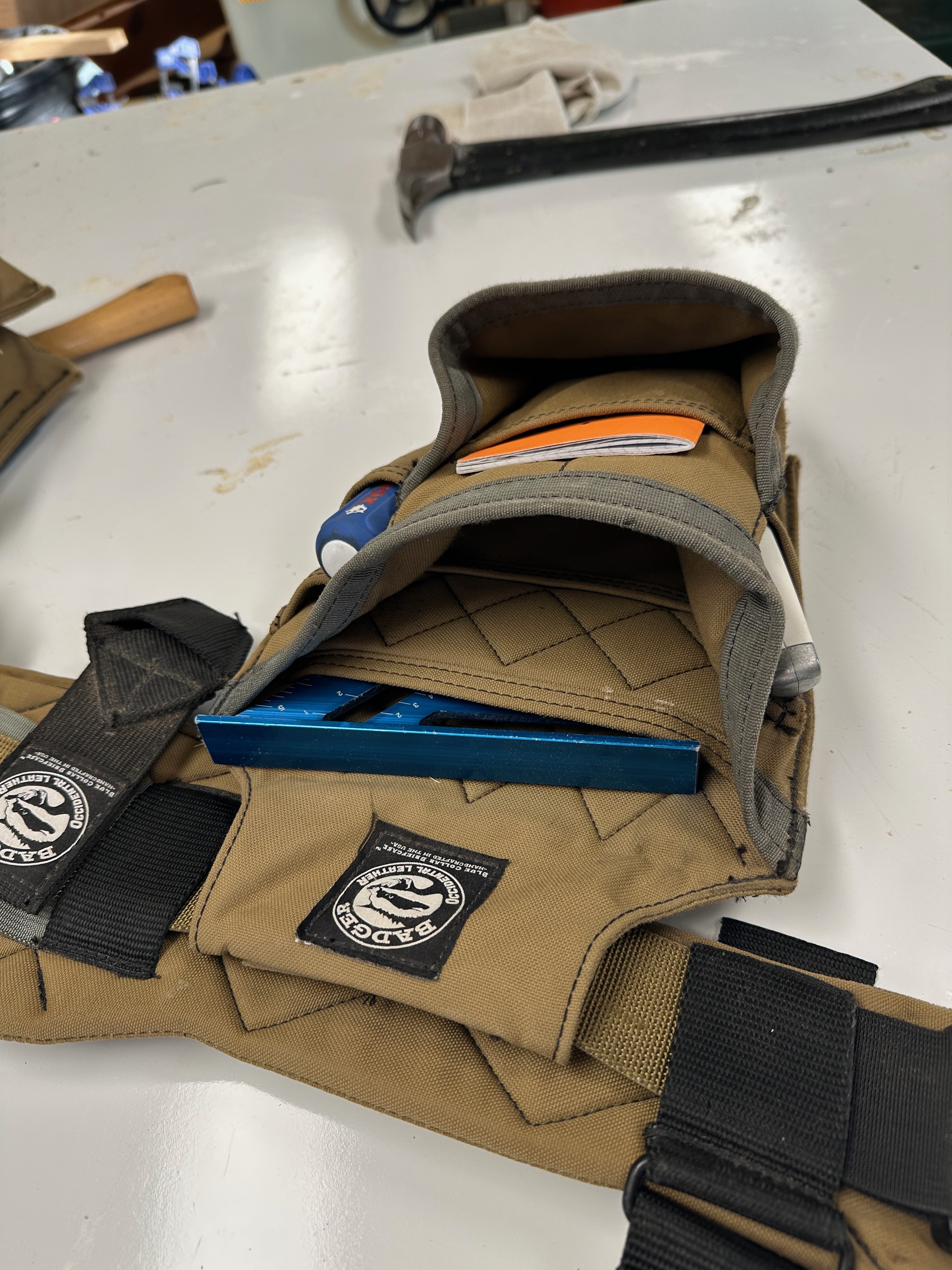
The right-front pockets have two pencil holders, but stitching made the front one too shallow for the pencils I use. I removed that stitching with a seam ripper, giving me two full-depth slots.
I carry two Pica-Dry 3030 pencils. One contains ordinary graphite; the other holds a yellow wax lead from the water-soluble refill set. The yellow lead is particularly useful when graphite is hard to see.
I also keep a Sharpie Industrial marker nearby for marks that need to be darker or more permanent.
Hammer and cat’s paw
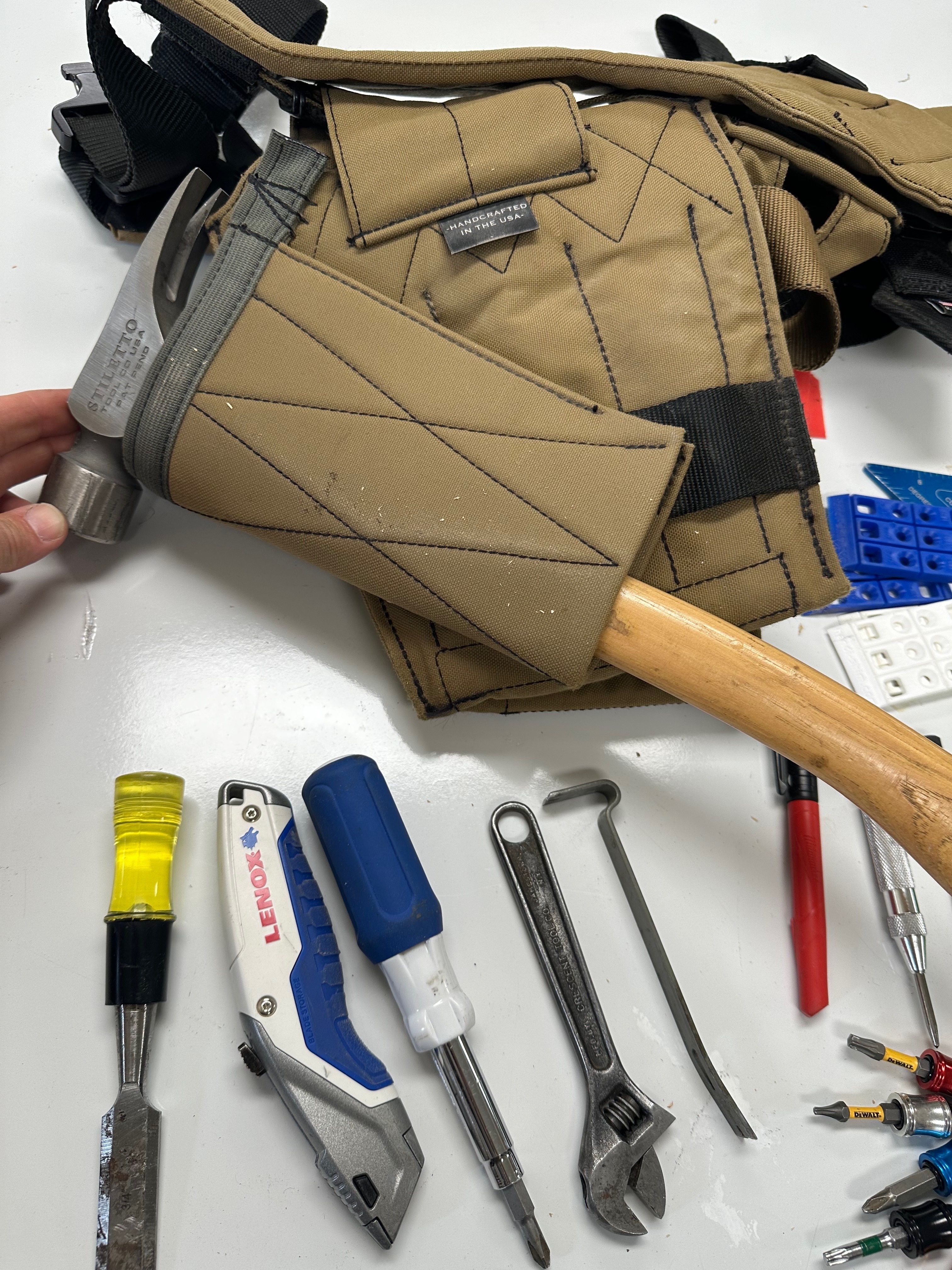
I carry a small cat’s paw in the left sleeve and a hammer in the right sleeve. The hammer sleeve works well while I am standing, but I can knock the hammer out when I spend a lot of time kneeling or sitting on my hip on a roof. For those jobs, I move it to the fabric loop on the back of the right bag.
What I carry
The contents change with the work. I do not carry the heavy demolition tools when I am installing trim, and I do not expect a compact remodeling belt to replace a dedicated electrical or plumbing kit. These are the tools that live in the belt most often or get added for particular jobs.
The complete loadout
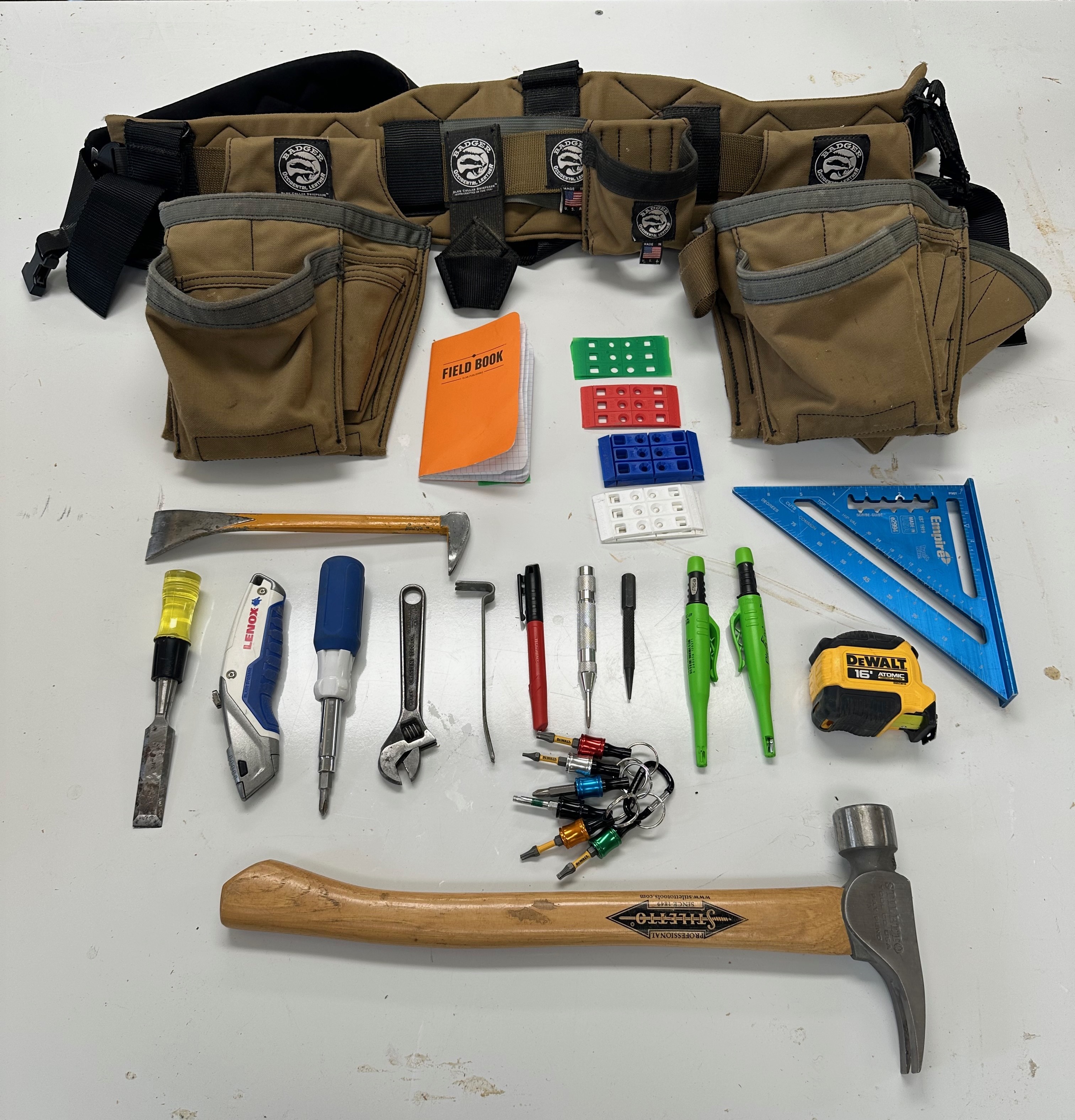
| Tool | What I use it for | How often I carry it |
|---|---|---|
| DeWalt 16-foot ATOMIC tape | General measuring; fractional markings are easy to call out | Daily |
| Two Pica-Dry 3030 pencils | Graphite and yellow wax marking | Daily |
| Sharpie Industrial marker | Darker and more permanent marks | Daily |
| Handi-Shim assortment | Spacing, leveling, measuring gaps, and setting reveals | Daily |
| Neiko automatic center punch | Starting screws and nails and marking locations | Daily |
| 1/32-inch Stanley nail set | Setting nails and fixing points that stand proud | Daily |
| Empire seven-inch rafter square | Layout, square cuts, and quick measurements | Daily |
| Elan graph notebook | Recording measurements instead of using scrap lumber | Daily |
| Lenox retractable utility knife with carbide blades | General cutting, including carpet and cardboard | Daily |
| Lenox 9-in-1 screwdriver | Phillips, slotted, square-drive, and common nut-driving work | Daily |
| Impact bits on a quick-release holder | Keeping assorted 1/4-inch bits organized | Daily |
| Six-inch Knipex Cobra pliers | Pulling, gripping, bending, breaking, and general repairs | Most days |
| Six-inch Crescent adjustable wrench | Unexpected nuts and bolts | Many days |
| Vaughan 222 Mini-Bar | Small prying jobs and pulling staples | Daily |
| ½-inch Hurricane chisel | Rough scraping, prying, striking, and chopping | Daily |
| Bostitch eight-inch molding nail puller | Everyday nail pulling and light prying | Daily |
| One of three hammers | Chosen for trim, framing, roofing, or demolition | Depends on the job |
| Long nail-pulling bar | Pulling stubborn ring-shank nails | Demolition days |
Measuring, marking, and spacing
One of my favorite—and least-known—things in the belt is an assortment of Handi-Shim plastic construction shims. I keep several in one of the slim pockets. They come in 1/32, 1/16, 1/8, and 1/4-inch thicknesses and are useful for spacing siding, setting trim reveals, leveling feet, measuring gaps, and keeping drawer faces evenly spaced during installation.
Put a few in your tool bag and you may be surprised by how often you reach for them.
I always carry a small Neiko automatic center punch. It is useful for marking locations and making starter dimples for screws, nails, and drill bits. It works with one hand and does not require a hammer.
I carry the smallest, 1/32-inch nail set from Stanley’s three-piece set. It sets finish nails and fixes the occasional nail or sharp point that has worked its way above a surface.
My favorite speed square so far is the Empire e2994 seven-inch aluminum rafter square. The laser-etched markings are crisp and easy to read, and it is a good square for the price. I would like more scribe-guide locations, but that has not kept it from becoming my everyday choice.
Before putting one in your tool bag, soften its sharp edges with sandpaper or a file. Rounded edges feel better in the hand and are kinder to the bag.
I also keep an inexpensive Elan 3½-by-5½-inch graph notebook in the belt so I do not constantly write measurements on scraps of lumber. These are essentially Field Notes knockoffs, but the graph paper is nice enough and the price is right for something that will live on a construction site.
Cutting and driving
The Lenox Pro Retractable Utility Knife has quick blade changes and stores spare blades in its body. It is a simple, well-designed knife.
I preferred Irwin Blue blades for years, but Lenox Carbide Edge blades beat them by a mile. The difference is most apparent on abrasive materials such as carpet and cardboard. They cost more, but in my experience their longer life makes them worth the premium.
The Lenox 9-in-1 screwdriver includes Phillips, slotted, and #2 and #3 square-drive bits. Its removable shafts also work as 1/4, 5/16, and 3/8-inch nut drivers, covering many common sheet-metal screws. It is great for surprise gutter work.
I keep a small collection of 1/4-inch impact bits on an inexpensive quick-release keychain holder. It keeps the bits organized and easy to reach without taking up a pocket. For the price, it works well, and I have not found an organizer I like better.
Gripping and adjusting
The six-inch Knipex Cobra pliers are worth their price. I use them for pulling nails and staples, bending things, breaking things, and generally fixing things. The five-inch version is also nice, but I believe the pair currently in my belt is the six-inch 87 01 150. It remains compact while offering a useful amount of grip and leverage.
The “baby” Crescent AT26VS adjustable wrench is in my belt many days. It is only six inches long but opens to 15/16 inch, so it handles a useful range of surprise fasteners without occupying much space.
Prying and demolition
The Vaughan 222 Mini-Bar is a tiny, 5½-inch flat bar. It slips into the belt easily and is useful for small prying jobs, pulling staples, and getting into places that do not call for a full-size bar.
I also carry the ½-inch chisel from this inexpensive Hurricane four-piece chisel set. Half an inch is a useful general-purpose size, and the chisel is cheap enough to be a beater. I can scrape, pry, strike, or otherwise abuse it without fussing over a fine woodworking edge.
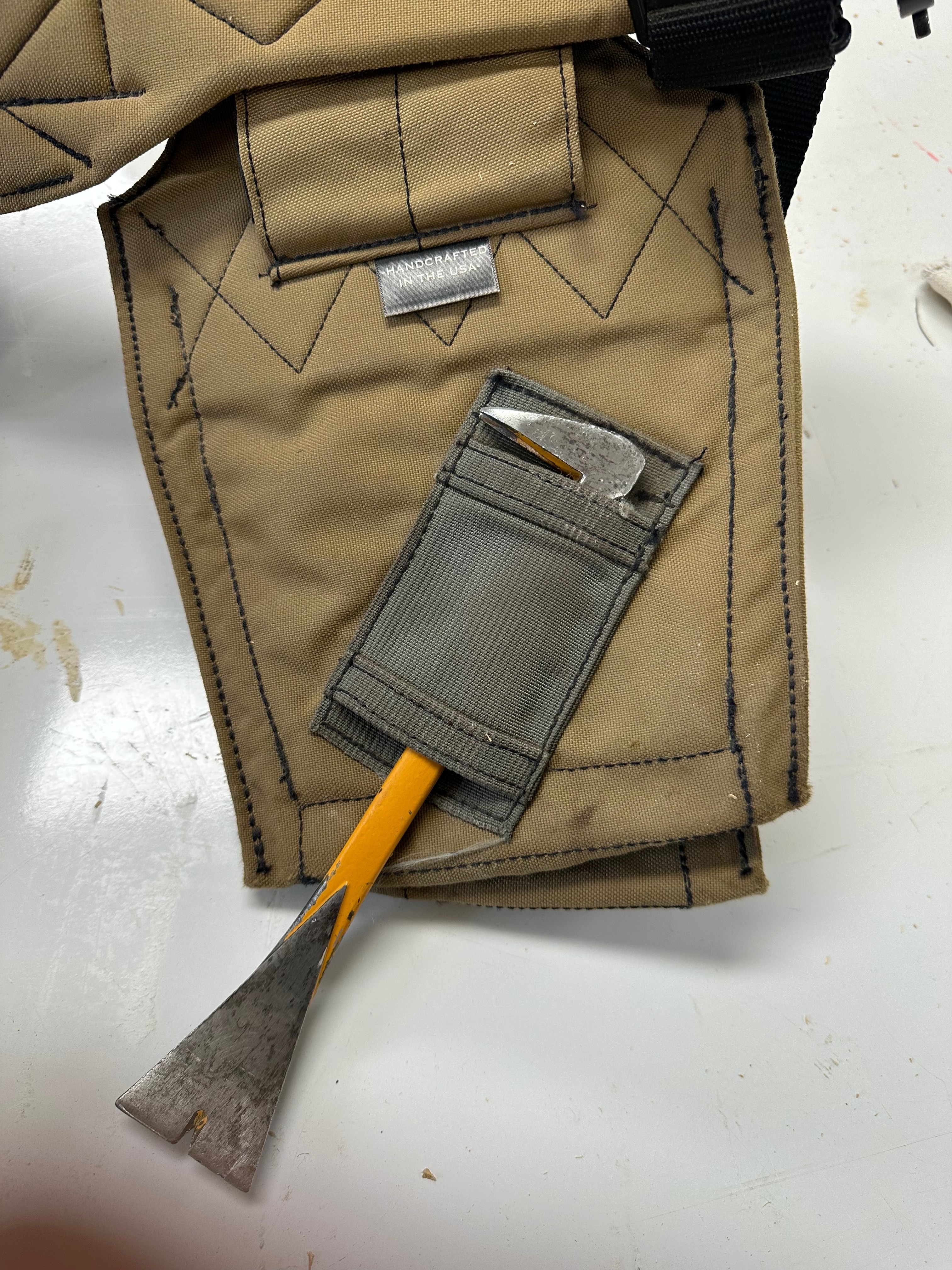
My everyday nail puller is a Bostitch eight-inch steel molding bar that is no longer available. It is small enough to carry but handles a great deal of ordinary pulling and prying. The closest current substitute I have found is the Klein Tools 66101 ten-inch molding bar. I have not used the Klein, but its built-in nail dimpler might make it nicer for exposing deeply set nails.
On demolition days, I add a longer nail-pulling bar. The extra length is perfect for stubborn ring-shank nails. This is also one of the loads that makes the suspenders worthwhile.
Three hammers for different work
I do not carry all three hammers at once. The job decides which one goes into the belt.
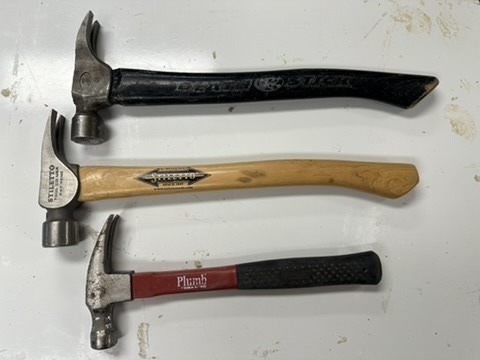
For framing, roofing, and demolition, I use the Dead On Tools DO21C. It is a heavy 21-ounce framing hammer with an 18-inch curved hickory handle, milled face, and straight claw. It is reasonably priced and has proven durable.
My grandfather carried a Stiletto TI14MC, and now I carry one too. The 14-ounce titanium head, milled face, and curved hickory handle make it a wonderful nail-driving hammer. The family connection makes it especially satisfying to carry.
For interior framing, I often use a Plumb 11415N with a smooth face. Mine is an older example, and the design may have changed over the years, but it has always felt well balanced and has been remarkably durable. I think it will last forever.
What I would change
The B12 is not cheap. It becomes a larger investment once you add the tape holster, suspenders, and quick-release hardware. After the amount of use mine has seen, I think the cost was justified.
The compact bags also require some discipline. Their size is the reason I bought them, but they are not intended to hold a complete kit for every trade. I change the load rather than cramming in more tools.
Most of my other qualifications are small and specific:
- The COBRA buckle may be difficult for arthritic fingers.
- The standard tape holster is better suited to my compact 16-foot tape than a bulky 30-foot model.
- The hammer sleeve is easier to knock loose when I am kneeling or sitting on my hip.
- I would like more scribe locations on the Empire square.
- The DeWalt tape blade could be a little stouter, although that would add weight.
None of these has made me regret the setup.
Would I buy it again?
Yes. The Badger B12 is light, comfortable, well organized, and compact enough for the varied work involved in renovating a house. The belt alone is excellent for lighter days. With the suspenders, I can load it for roofing, framing, or demolition without concentrating all that weight on my hips.
The strongest recommendation I can give is that I have worn it nearly every day after work and through long renovation weekends since May 2025. I bought the suspenders expecting to remove them as needed, then never removed them. I modified one pencil pocket, moved a few tools around, and kept working.
It is an investment, but it is one of my favorite tool purchases. I would absolutely buy it again.